Using strategy to achieve transformational change is hard. Over the past decade, I've worked on community spatial plans, growth strategies, infrastructure programmes and regional initiatives across New Zealand. While every project is different, the most successful ones tend to combine a common set of tools. At their core, these tools help answer a simple question: how do we move from discussing the future to actively shaping it?

Tool 1: Tell a Story That Helps People Buy In
Most strategic plans begin with a vision or set of objectives, but the best create a simple narrative. If people cannot explain the story of a strategy in a few sentences, they are unlikely to champion it and help deliver it. Why should people care? Where’s your strategy’s response to: “so, what…?”
A vision tells people where you want to go, objectives tell them what you want. A narrative explains why it matters, how different pieces fit together, and lays out a roadmap to get from here to there. It bridges technical analysis and decision-making. This is critical to maintain momentum as projects move from planning into implementation.
Tool 2: Use Scenarios to Make Change Less Scary
Many planning projects look for the right answer too early. Scenario planning takes a different approach. Instead of debating a preferred option off the bat, scenarios let you work with groups to explore multiple plausible futures and test their implications. This puts aside day-to-day reality and creates a structured environment for discussing trade-offs before positions become entrenched.
I have found that scenarios often create better conversations than draft plans because they temporarily suspend the immediacy of decisions to invite exploration rather than defence. They help make complex decisions more transparent by showing why certain outcomes or recommendations emerge and that options were considered and doors closed or opened deliberately.
Tool 3: Expose Trade Offs to Enable Solutions
Planning decisions are never driven by a single factor. Infill housing might seem efficient and cost-effective but creates unaffordable infrastructure challenges or industrial development may be great for council’s rating base but generates costly stormwater effects. Principles provide a simple and accessible way to expose trade-offs.
A clear set of agreed principles can help people test options, understand implications and make judgement calls without turning the process into a technical scoring exercise. Used well, principles allow technical inputs, community aspirations and strategic objectives to be considered together. They make compromises visible while keeping the conversation focused on values, outcomes and practical judgement.
Tool 4: Break Silos with Place-Based Discussion
Many of the strongest ideas emerge when stakeholders and delivery teams work together around a map. It’s easy to look at different business lines in Councils to see delivery priorities in a silo. It’s much harder to look at how planned investments can work together to deliver place-specific outcomes.
Place-based workshops provide an opportunity to test ideas, identify constraints and explore opportunities collaboratively. I have repeatedly found benefit in pulling asset managers from across council into a room to gather around a map of a community to talk as a group about how they are investing into a place. Inevitably there are light-bulb moments, and for some it’s the first time they’ve looked at investments as integrated programmes that are about a specific community.
Tool 5: Engagement Must Shape the Strategy
The best projects I’ve worked on shape engagement into the strategy not vice versa. They are built by combining technical evidence with local knowledge, lived experience and community aspirations. Engagement must have a leading role to make this work because it gives you the purpose of the strategy and adds depth so people see their interests in the outcomes (which leads to support). In particular Iwi and Mana Whenua add a valuable depth of information about a place and bring an intergenerational perspective that results in better strategic planning.
Across Ahu Ake, Our Places and other spatial planning projects, early engagement with Iwi and Mana Whenua, youth, businesses, community groups and infrastructure providers helped identify opportunities, constraints and priorities that were not visible through data alone. Youth voices challenged established assumptions. Iwi engagement strengthened understanding of environment, place, and long-term aspirations. Private sector input helped ensure strategies were grounded in implementation realities and investment opportunities.
Tool 5: Agree Shared Evidence (Early)
Complex projects usually involve multiple organisations, disciplines and perspectives (this is part of the fun!). As a result, a surprisingly large amount of effort can be lost debating facts rather than discussing solutions. These are not my favourite Teams meetings. Successful projects establish a common evidence base early.
Whether it is growth projections, infrastructure data, natural hazard information or housing capacity assessments, shared evidence creates a common starting point for decision-making. It does not eliminate disagreement, but it creates a more productive conversation about what should happen next.
Tool 6: Organisational Change
Many planning projects focus heavily on the deliverable - the document or business case - not what happens after. Fewer focus on what needs to change inside an organisation for that work to succeed. Implementation can need new behaviours, new governance arrangements, new decision-making processes and, in some cases, entirely new capabilities. If these aren’t considered early, even the best technical work struggles to gain traction.
My experiences with Ahu Ake and Our Places highlighted the value of involving council staff from multiple levels of the organisation throughout the process, combining expertise with local knowledge, and building internal ownership of recommendations before plans are finalised. Implementation is ultimately about people and organisations. Organisational outcomes are often just as important as the plan itself.
Tool 7: Key Moves for Disproportionate Benefits
One of the biggest traps in strategic planning is trying to solve every problem at once. There is no shortage. In preparing an integrated strategy, everything competes for attention at once. The temptation is to include everything in the plan for fear of missing something important. But the problem is that implementation efforts become spread too thin.
The most effective planning projects identify a small number of transformational actions that will have the greatest influence on future outcomes. Focus resources on the decisions, investments and partnerships that will unlock the greatest scale of changes. Hone into opportunities for disproportionate benefits. Don’t try to do it all, help organisations understand what they should do first.
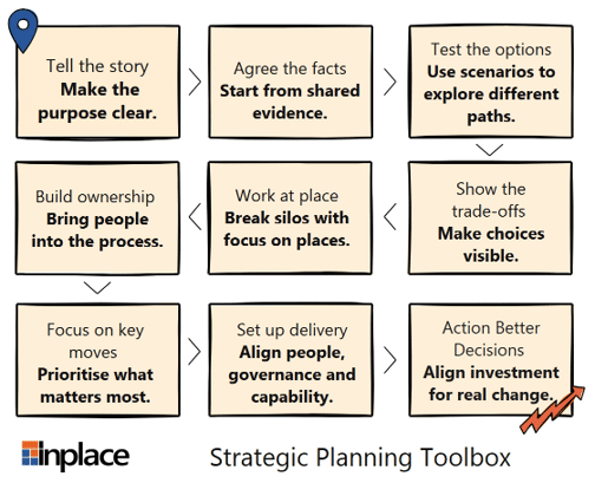
Bringing the Toolbox Together
The value of these tools comes from combining them into a coherent approach: a compelling narrative, a strong evidence base, tested scenarios, structured decision-making, collaborative engagement and a clear pathway to implementation focused on oversized benefits. While there are always more tools you could add, these are some of the core technical approaches that I see repeated across many strategic planning projects. What this looks like is different everywhere I practice. The local people and context determine the focus.

